Standard ISO 12944
Corrosion protection of steel structures by protective paint systems.
Anticorrosive protection systems
ISO 12944-5 describes the most common coating systems used to protect steel structures against corrosion, the recommended thicknesses and the number of layers to apply.
This Pyrolac guide, based on the standard's recommendations, helps select the most appropriate system according to the environment, surface preparation grade and estimated durability.
Atmospheric corrosion categories
Mass and thickness loss per unit area, with examples of typical environments in temperate climates.
| Category | Low-carbon steel | Zinc | Exterior | Interior | ||
|---|---|---|---|---|---|---|
| Mass (g/m²) | Thickness (µm) | Mass (g/m²) | Thickness (µm) | |||
C1Very low | ≤ 10.0 | ≤ 1.3 | ≤ 0.7 | ≤ 0.1 | — | Heated buildings with clean atmospheres: offices, shops, hotels, schools. |
C2Low | 10.0 – 200.0 | 1.3 – 25.0 | 0.7 – 5.0 | 0.1 – 0.7 | Atmospheres with low pollution levels. Mostly rural areas. | Unheated buildings with possible condensation: warehouses, sports halls. |
C3Medium | 200.0 – 400.0 | 25.0 – 50.0 | 5.0 – 15.0 | 0.7 – 2.1 | Urban and industrial atmospheres, with moderate SO₂ pollution. | Manufacturing plants with high humidity: food processing, laundries, breweries, dairies. |
C4High | 400.0 – 650.0 | 50.0 – 80.0 | 15.0 – 30.0 | 2.1 – 4.2 | Industrial and coastal areas with moderate salinity. | Chemical industries, swimming pools, ships and shipyards. |
C5Very high | 650.0 – 1500.0 | 80.0 – 200.0 | 30.0 – 60.0 | 4.2 – 8.4 | Industrial areas with high humidity and aggressive atmosphere. | Buildings or areas with almost permanent condensation and high pollution. |
CXExtreme | >1500 a 5500 | >200 a 700 | >60 a 180 | >8.4 a 25 | Offshore structures and industrial areas with extreme humidity, aggressive, tropical and subtropical atmospheres. | — |
Water and soil categories
Expected corrosive agents when the structure is submerged or buried.
Fresh water
Riverside installations, hydroelectric plants.
Sea or brackish water
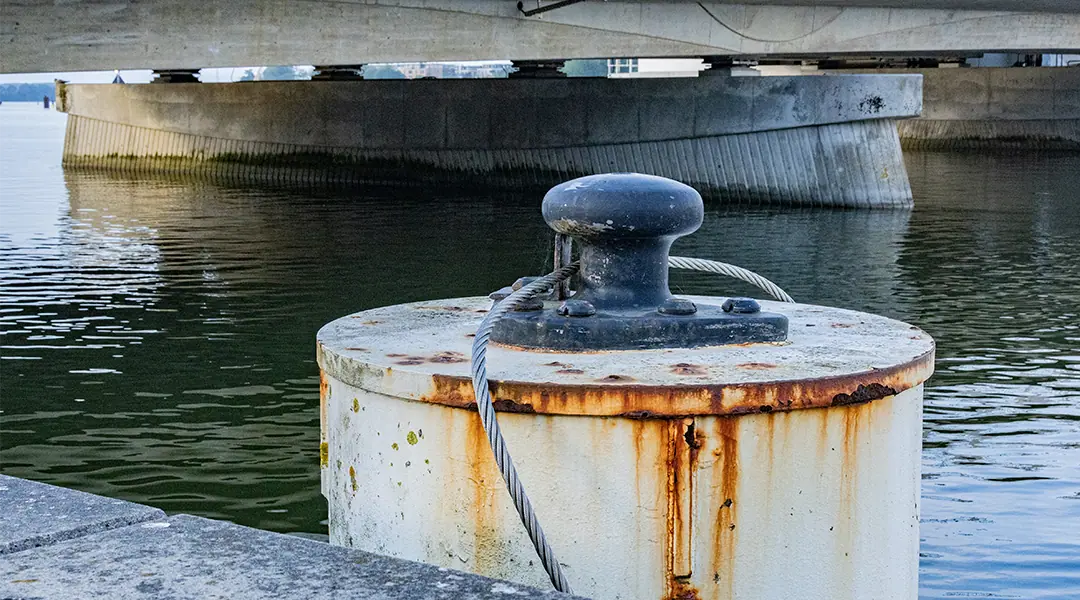
Port areas: lock gates, sluices, breakwaters, offshore structures.
Soil
Buried tanks, steel piles and pipelines.
Sea or brackish water with cathodic protection
Port areas with active cathodic protection.
Durability classes
Years until the first repainting maintenance. Durability does not represent a warranty period.
Low
up to 7 years
Medium
7 to 15 years
High
15 to 25 years
Very high
over 25 years
Surface preparation
Before blast-cleaning, all visible traces of oil, grease, salts and other contaminants must be removed so they do not remain embedded in the steel or contaminate the abrasive.
- Oil, grease or water-soluble salts: water jet cleaning (with detergent if necessary), steam, emulsifiers or organic solvents. Always rinse with clean water.
- Welding spatter, non-water-soluble salts or cement: use mechanical or manual tools (brushes, scrapers, etc.).
- Corners, edges and weld beads: round off (minimum 2 mm diameter) to facilitate coating.
- Abrasive blast-cleaning per EN ISO 8501-3 with average roughness profile between 25 and 50 µm (Testex Tape or G/S comparators per ISO 8503).
- Final cleaning by powerful vacuuming. Dust-free surface: applying adhesive tape should not pick up dust.
Maximum time between blast-cleaning and paint application must be 4 to 6 hours depending on ambient conditions. If oxidation appears before painting, blast-clean again to restore the required cleanliness level.
Pyrolac paint systems
Systems compliant with ISO 12944 in product type, thicknesses and number of layers. Alternatives exist — please contact our customer service.
Sistema epóxico + poliuretano
| Anticorrosive coating | Pyrolac product | Dry film (mils) |
|---|---|---|
| Zinc phosphate epoxy primer | SUBOX E | 2.0 – 3.0 |
| Polyurethane finish | SUBALOX U | 2.0 – 3.0 |
| Total thickness | 4.0 – 6.0 | |
Sistema epóxico modificado + poliuretano
| Anticorrosive coating | Pyrolac product | Dry film (mils) |
|---|---|---|
| Modified epoxy primer | SUBOX E AR | 3.0 – 4.0 |
| Polyurethane finish | SUBALOX U | 2.0 – 3.0 |
| Total thickness | 5.0 – 7.0 | |
Need help selecting the right ISO 12944 system?
Our technical team can guide you on corrosion category, surface preparation and the most suitable paint scheme for your project.